Work Packages
The four institutes work closely together in the project and share the main responsibilities across
the project’s work packages (WP).
April 2026 – March 2028:
WP I (JLU): The OPCW as a Law-Making International Organization – Identifying the OPCW’s actions that contribute to customary international law and assessing their impact on other actors in international law.
WP II (JLU): Verification under the CWC – Analyzing and evaluating various verification concepts and their applicability to the Chemical Weapons Convention (CWC).
WP III (IFSH): Key Actors and Their Influence on CBW Prohibition Regimes – Analyzing the conduct of key actors and its impact on the two prohibition regimes for chemical and biological weapons (CBW).
WP IV (IFSH): Norm Contestation and Integration – Analyzing the contestation of norms against CBW and their integration into the prohibition regimes, while formulating options to enhance norm resilience.
WP V (PRIF): (Non-)Compliance with Norms Against CBW, and Their Robustness and Resilience – A theory-driven and practice-oriented analysis of (non-)compliance and its influence on CBW norms.
WP VI (PRIF): Norm Compliance, Addressing Norm Violations, and Disinformation – Analyzing compliance and enforcement instruments and mechanisms, and identifying ways to strengthen them.
WP VII (ZNF): Less-Lethal Weapons in the Context of Recent Scientific and Technological Developments – Examining debates surrounding such substances within CBW prohibition regimes, as well as the potential impact of science and technology (S&T) – for instance, regarding bioregulators as a possible expansion of the spectrum of agents.
WP VIII (ZNF): Project Coordination and Synthesis of Research Findings – Coordinating project, practice, and transfer network partners; synthesizing and disseminating research findings in a summarizing CBWNet Working Paper.
WP IX (IFSH): Transfer – Supporting the transfer of research findings to political practitioners, the academic community, and the interested public, via CBWNet website, newsletter und working papers.
April 2022 – March 2026:
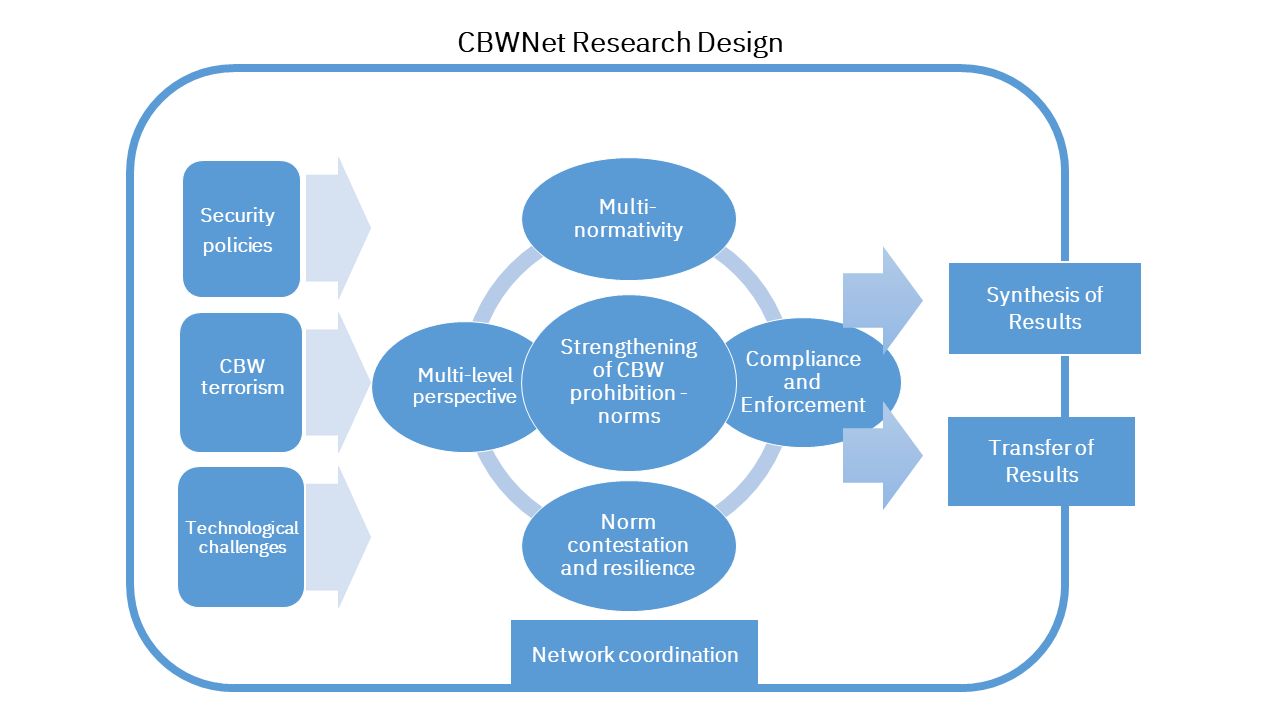
WP 1 (JLU): Multinormativity - Categorization of the different types of norms constituting and
shaping the CBW prohibitions, their interactions and their effectiveness.
WP 2 (JLU): Multi-level perspective - Analysis of the interactions between the different norms created at different levels, with particular reference to national law.
WP 3 (IFSH): Norm contestation and resilience - Analysis of the CBW prohibition norms, assessment of their weakening, and formulating options to increase their resilience.
WP 4 (PRIF): Compliance and Enforcement - Analysis of the framework conditions and practice of
compliance and enforcement of norms in the CBW regimes, discourse analysis of state positions.
WP 5 (IFSH): Security policy framework - analysis of changing interests and the actions of key actors
and their effects on the two CBW prohibition regimes.
WP 6: (IFSH): CBW Terrorism - Analysis of the emergence of CBW terrorism, its impact on the CBW
prohibition regimes, and evaluation of measures taken to strengthen regime implementation.
WP 7 (ZNF): Technological challenges - S&T mapping, creation of scenarios, proposals for education and training in various R&D facilities.
WP 8 (PRIF): Synthesis of research results - Merging and synthesis of the results of all WPs, publication in edited volume.
WP 9 (IFSH): Transfer and policy advice - Transfer of research results to political actors, to the
academic specialist audience, and the interested public.
WP 10 (IFSH): Project coordination - Coordination of the network activities and the exchange with the implementation partners from the Federal Foreign Office and Leopoldina as well as the CBWNet
transfer network through the Berlin IFSH office